
By Marrakech Riads & Tours guide team — Local Morocco travel specialists
Essaouira Day Trip from Marrakech: The Local Guide
Plan the perfect Essaouira day trip from Marrakech — Portuguese ramparts, Atlantic seafood, blue medina, argan goats, and Game of Thrones filming spots, 2.5 hrs west.

Marrakech in July sits at 40°C and barely blinks. Essaouira, 2.5 hours west on the Atlantic coast, is 22°C and permanently breezy. That temperature gap alone has been sending Marrakchis — and smart travellers — to this whitewashed port city for centuries. But Essaouira delivers far more than cool air: Portuguese sea ramparts built in the 18th century, a UNESCO-listed medina painted in blue and white, a working fishing harbour where the catch lands at dawn, and a coastline that doubles as one of the world's top windsurfing venues. If you have one spare day from Marrakech, this is the day trip that surprises people most.
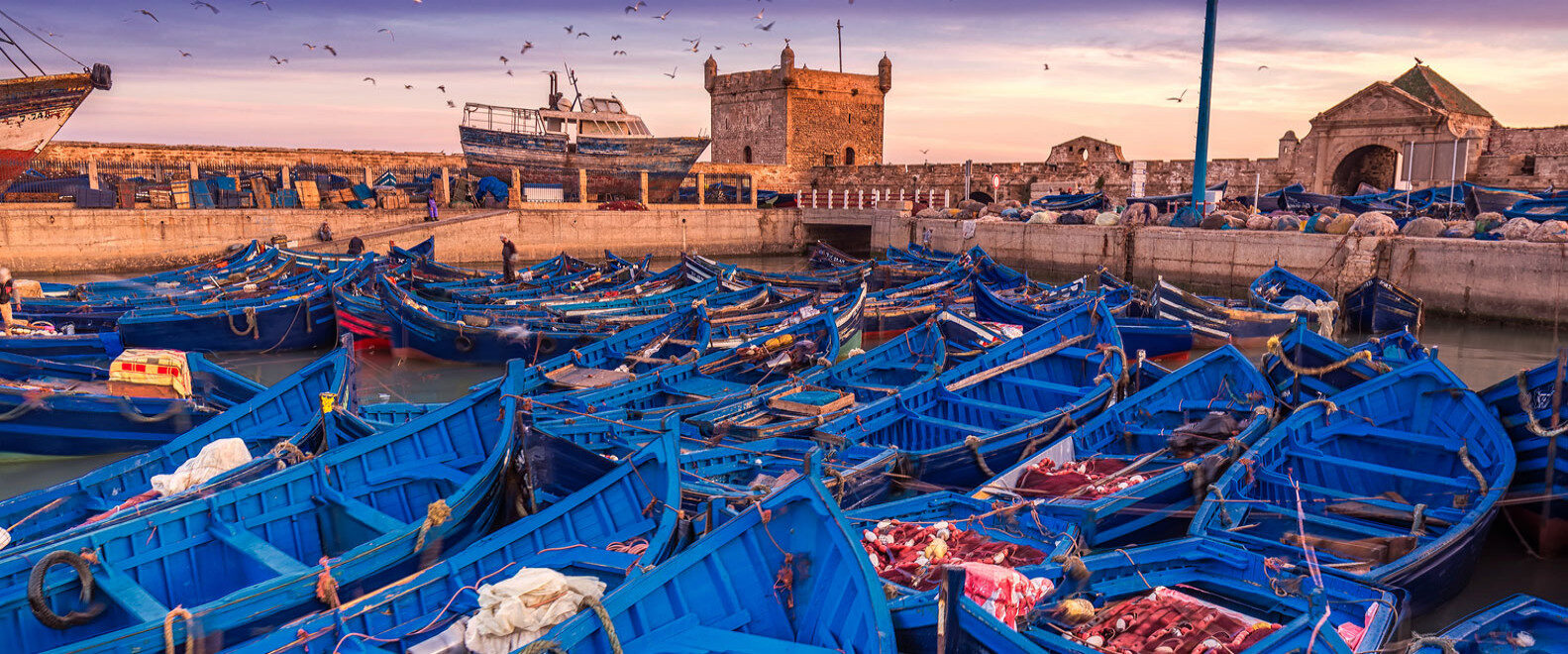
Essaouira day trip at a glance
| Detail | Info |
|---|---|
| Distance from Marrakech | ~175 km |
| Drive time | 2.5 hours each way |
| Best season | Year-round; ideal May–Sep when Marrakech is hottest |
| Typical day-trip window | 9 a.m. depart → 7 p.m. return |
| Key sites | Skala ramparts, fishing port, medina, argan cooperatives |
| Known for | Seafood, windsurfing, Game of Thrones (Astapor) |
| UNESCO status | Medina listed since 2001 |
We run every Essaouira trip as a private day with a licensed guide and hotel pickup — browse our tours from Marrakech or compare it with the other day trips from Marrakech we recommend.
Getting from Marrakech to Essaouira
The road west through the Haouz plain is one of Morocco's more pleasant drives — flat red earth giving way to argan scrubland and the first Atlantic light. No mountain passes, no switchbacks. Options:
- Private car and driver (recommended). Door-to-door from your riad, flexible stops en route. We include this in every itinerary we build.
- Supratours bus. Several departures daily from Marrakech bus station. Comfortable but fixed schedule — limits your time in Essaouira.
- Shared grand taxi. Cheaper, departs when full from Bab Doukkala. Less predictable timing.
If you want to stop at argan cooperatives or photograph the tree-climbing goats on the way, a private transfer is the only practical option.
Argan cooperatives and the tree-climbing goats
About halfway along the Marrakech–Essaouira route, argan trees begin lining the roadside. Argan oil — pressed from the hard-shelled nut inside the argan fruit — is one of Morocco's most valuable exports, used in both cuisine and cosmetics. What surprises nearly every visitor is what else is in the trees: goats. Moroccan goats climb argan trees to eat the fruit, then spit or pass the nut, which is collected and cold-pressed by hand. It is exactly as strange as it sounds, and exactly as photogenic.
We make a stop at a genuine women's argan cooperative (not a commission shop) where you can watch the traditional stone-grinding process, taste argan oil fresh, and buy directly from the women who produced it. Skip any roadside stand that advertises itself in six languages and has a tour-bus car park — the real cooperatives are quieter and worth seeking out.
The Skala ramparts and Portuguese fortress
Essaouira's great stone walls — the Skala de la Ville and the Skala du Port — were designed by a French engineer named Théodore Cornut in the 1760s on the orders of Sultan Mohammed III. The Portuguese had controlled the site (calling it Mogador) a century earlier, and traces of their fortifications sit beneath the later Moroccan walls.

Walking the sea-facing Skala is the first thing we do with every group. The wind comes in hard off the Atlantic, the brass cannons still point seaward, and the view of the medina's white-and-blue rooftop terraces is the defining image of Essaouira. Go early — the light is best before 11 a.m. and the ramparts get busier through the day.
The Castelo Real de Mogador (the original Portuguese island fortress, visible offshore) is accessible by boat and worth the short crossing if your schedule allows.

The fishing port and the freshest seafood in Morocco
The working harbour south of the Skala du Port is where Essaouira earns its reputation. Wooden blue fishing boats, stacked lobster pots, weathered nets, and a fish auction running most mornings — it is a genuine working port, not a tourist reconstruction. By midday the catch from overnight boats is laid out on grills at the open-air fish market just inside the medina gate.
Lunch here is non-negotiable. You point at what you want — sardines, sea bass, squid, prawns — it goes on the grill immediately, and you eat it minutes later with a wedge of lemon and a piece of flatbread. The quality is extraordinary and the experience is entirely local. This is one of the moments our guests most often mention months later.
The blue-and-white medina
Essaouira's UNESCO-listed medina is genuinely walkable in a way that Marrakech's is not. The grid layout — a legacy of the 18th-century French design — means you are unlikely to get truly lost. The streets are quieter, the vendors less aggressive, the pace slower. Blue-painted window frames and doors break the white plaster at every turn.
Key medina stops:
- The souks — woodworking in local thuya wood (Essaouira's craft specialty), silver jewellery, spices
- Place Moulay Hassan — the main square, best for a mint tea break, ringed by cafés
- Rue de la Skala — the main medina artery, lined with thuya woodworkers whose workshops open onto the street
- The mellah (former Jewish quarter) — remnant of Essaouira's once-significant Jewish population, now quiet and largely residential
- The rooftop terraces — several café-restaurants have terraces above the medina with Atlantic views
Allow two to three hours just for the medina. If you rush it, you've missed it.
Game of Thrones: walking the streets of Astapor
Essaouira served as Astapor in Season 3 of Game of Thrones — the Slaver's Bay city where Daenerys acquires the Unsullied. The slave market scenes were filmed primarily around the Skala du Port and along the coastal ramparts, with the medina's twisting lanes used for the surrounding city streets.
Fans will recognise specific corners and archways immediately. For everyone else, the backdrop — wind-scoured stone walls, Atlantic light, blue sea — makes the filming logic obvious. It is one of the more striking Game of Thrones locations precisely because so little set-dressing was needed. Essaouira already looks like another world.
Windsurfing and kitesurfing
The beach stretching south from Essaouira — Plage de Sidi Kaouki — is classified among the world's top wind sport locations. The Alizé trade winds blow consistently from the north between April and October, creating ideal conditions for both windsurfing and kitesurfing. Several surf schools operate on the beach and offer single-day lessons for beginners.
For a day trip, this works as an add-on to the medina and ramparts if you have a free hour in the afternoon, or as the centrepiece of the day if wind sports are your priority. The beach itself is wide, clean, and much less crowded than anything near Marrakech.
Day trip vs overnight — which should you choose?
Essaouira as a day trip works well — 2.5 hours each way leaves you five to six hours in the city, which is enough for the ramparts, the fishing port, a medina walk, lunch, and one atmospheric corner café. You will not feel shortchanged.
Essaouira overnight is better, and not by a small margin. The city changes entirely at dusk when the day-trippers leave: the medina empties out, the Gnaoua musicians come out in the lanes, the fish restaurants light up, and the Atlantic sky turns extraordinary colours over the sea walls. Morning is even better — the souks before 9 a.m. with almost nobody in them, the port at dawn, the entire blue-and-white medina in the early light.
If you can spare a night, pair it with a riad stay in the medina — there are several well-run boutique options inside the walls. We handle bookings for our guests as part of any wider Morocco tour we design.
Best time to visit Essaouira from Marrakech
Essaouira is one of the few Morocco destinations that works well year-round:
- May to September — the best time. When Marrakech is at its most punishing (35–42°C), Essaouira is around 20–25°C with Atlantic breezes. The contrast is dramatic and welcome.
- October to April — quieter, occasional Atlantic squalls, but the city is peaceful and the light in winter is exceptional. Pack a windproof layer.
- June through August — peak season for windsurfing and the Gnaoua World Music Festival (mid-June), which brings international musicians to the medina for four days of free outdoor concerts.
Building your Essaouira day trip
We design every Essaouira excursion as a private day with a licensed local guide and a comfortable car, hotel pickup and drop-off, and one clear price. No per-stop commission, no group minibus schedule.
- Departing from Marrakech, we typically stop at a genuine argan cooperative en route, spend the morning on the ramparts and port, break for grilled seafood at the fish market at lunch, and explore the medina through the afternoon before driving back before sunset
- Free 24-hour itinerary: tell us your dates at /#contact and we'll send a complete Essaouira day plan within 24 hours
- Combine with other day trips from Marrakech for a full week of excursions
- Extend into a broader Morocco destinations tour if Essaouira sparks an appetite for more coast
Ready to go? Get your free Essaouira itinerary — a licensed Marrakech guide will respond within 24 hours.
Essaouira day trip from Marrakech — FAQ
The questions our guests ask most before booking an Essaouira excursion.
Yes — it is consistently the day trip our guests enjoy most. The contrast with Marrakech is striking: the city is cooler, quieter, and entirely different in character. The ramparts, the fishing port lunch, and the walkable medina alone justify the 2.5-hour drive. An overnight is better, but the day trip delivers excellent value.
Filed under
Morocco Journal
Let's turn this story into your itinerary.
See private day trips and multi-day routes from Marrakech, planned with licensed local guides.
Continue reading
All stories →
Marrakech in 3 Days: A Realistic First-Timer Itinerary
Plan three full days in Marrakech with a walkable medina route, Bahia Palace, Majorelle, proper breaks and clear advice on what to book and what to skip.

Best Time to Visit Morocco: Month-by-Month
Month-by-month guide to Morocco weather, seasons and regions — from Marrakech and the Sahara to the Atlas and Atlantic coast — so you pick the perfect time to visit.

10-Day Morocco: Marrakech, Fes & Chefchaouen
The definitive 10-day Morocco itinerary: Marrakech, Atlas, Sahara dunes, Fes medina & Chefchaouen blue city — paced, private, and arranged by licensed local guides.