
By Marrakech Riads & Tours guide team — Local Morocco travel specialists
Marrakech, Meet the Unexpected: A Local's Guide to the Red City
A Marrakech-based travel agency's guide to the Red City — medina, Gueliz, Hivernage, Palmeraie — what to do, what to skip, where to escape the crowds and what only locals know.


Marrakech is two cities pressed against each other: the 1,000-year-old walled medina inside the 19 kilometres of red ramparts, and the modern French-built Gueliz / Hivernage districts that grew up outside the walls after 1912. Most travellers see only half of one of them. This guide is what we tell our own guests — what to do in each district, what's overrated, and where the city's actually surprising side hides.
The four districts you need to know
| District | What it is | Best for |
|---|---|---|
| Medina | Walled old city, founded 1062 | Souks, palaces, riads, Jemaa el-Fna |
| Gueliz | French colonial new town, 1913+ | Boutiques, restaurants, art galleries |
| Hivernage | Garden suburb, 5-star hotels | Pools, nightlife, spas |
| Palmeraie | 15,000-acre palm grove, 15min north | Resorts, golf, horse riding, families |
You can walk the medina in a day, but plan 3-4 nights minimum to actually enjoy it without rushing.
For the order to visit these areas, use our Marrakech in three days plan: medina first, southern palaces next, then Majorelle and a slower final afternoon.
Inside the medina — the 8 essentials
1. Jemaa el-Fna at sunset

The square that defines Marrakech. UNESCO-listed in 2008 for its oral storytelling tradition. By day: snake charmers, henna artists, fortune tellers. By 5 p.m. sharp the square transforms — within an hour 100+ food stalls roll into place and the place becomes the largest open-air dining hall in Africa. Eat stalls 14 (harira), 32 (snail soup) or 75 (grilled lamb) — the locals' favourites.
2. Koutoubia Mosque
The 12th-century minaret was the architectural blueprint for La Giralda in Seville and Le Tour Hassan in Rabat. Non-Muslims can't enter the prayer hall but the surrounding gardens are some of the best people-watching in the city — especially at sunset.
3. Bahia Palace
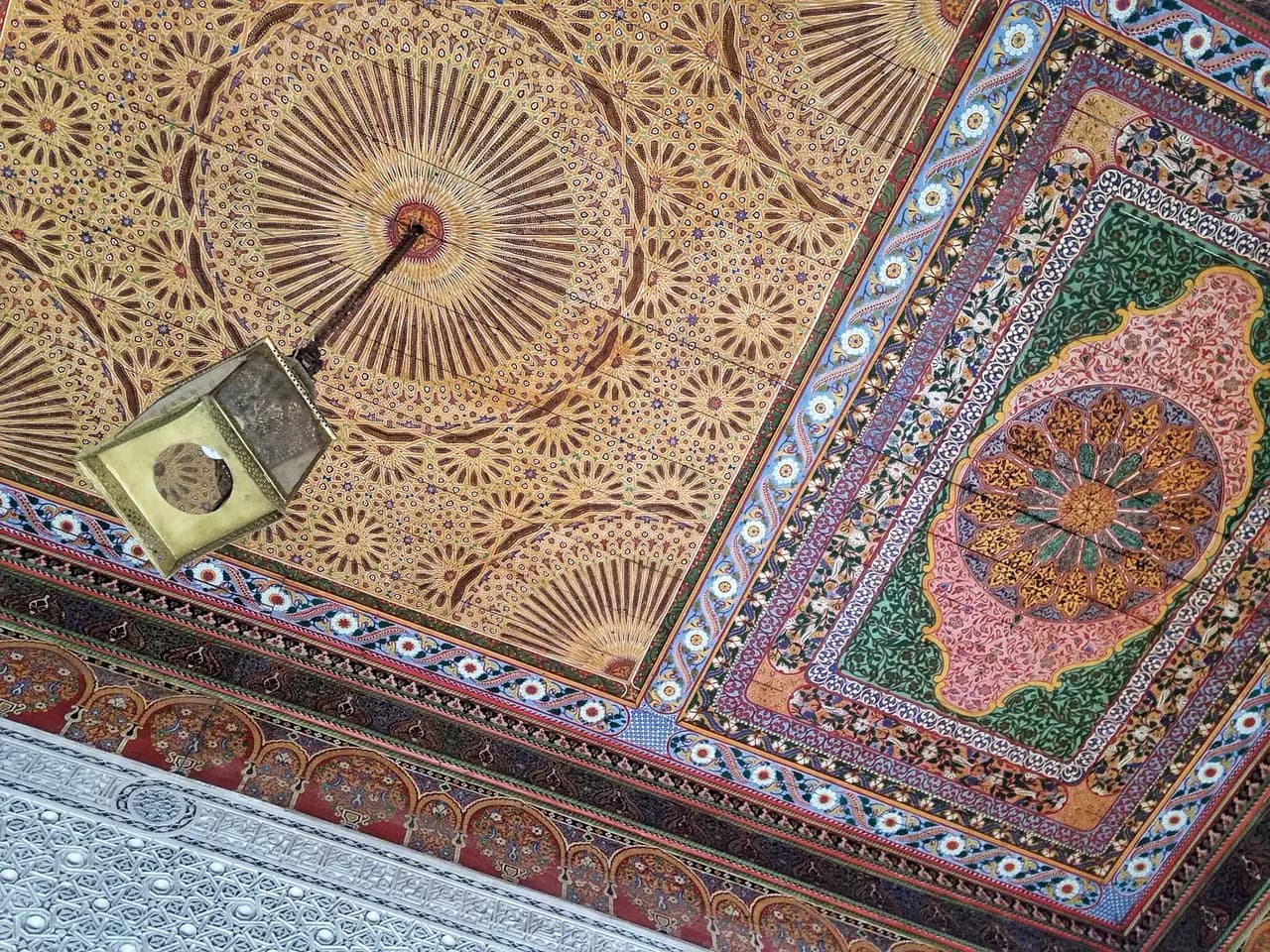
Built between 1859 and 1900 by Grand Vizier Si Moussa, then expanded by his son. Eight hectares, 150 rooms, painted-cedar ceilings that took artisans 14 years. Easily worth 1.5 hours.
4. Saadian Tombs
The 16th-century necropolis sealed behind a wall by Sultan Moulay Ismail in 1672 and rediscovered only in 1917 when a French aerial reconnaissance flight noticed an unexplained walled space. The mausoleum of Sultan Ahmed al-Mansur has 12 columns of imported Italian Carrara marble.
5. Ben Youssef Madrasa
The largest Quranic school in North Africa, founded in the 14th century. Restored 2020-2022 and reopened — the carved cedar courtyard, zellige tilework and stalactite plasterwork are the most refined craftsmanship in Marrakech.
6. El Badi Palace (pictured at top)
"The Incomparable" — built by Ahmed al-Mansur in 1593 using gold paid in ransom for Portuguese prisoners. Stripped to its earthen skeleton by Moulay Ismail a century later (he took everything to Meknes). What remains is the most atmospheric ruin in Morocco, with storks nesting in the walls. Go in late afternoon.
7. The souks — a navigation cheat sheet
Most travellers wander randomly and bounce out exhausted. The souks are actually organised by trade:
- Souk Semmarine (main artery) — textiles, leather
- Souk Smata — slippers and babouches
- Souk Haddadine — blacksmiths, lanterns
- Souk Cherratin — leather workshops
- Souk Sebbaghine — dyers (the tie-dye yarn hanging across the alleys)
- Souk el Attarine — spice and herbs
- Souk Chouari — woodworkers
- Souk Cherifia — modern designer boutiques (the new wave)
Bargaining: aim for 40-50% of the asking price for tourist items, 70-80% for genuine craft. Always walk away once before settling.
8. The hidden gems most travellers miss
- Le Jardin Secret — a restored 16th-century riad with two interior gardens. Quietest spot in the medina.
- Maison de la Photographie — 3-floor restored riad, 8,000 historic Moroccan photos, terrace café with the best view of the Atlas.
- Mellah — the old Jewish quarter. The 16th-century synagogue, the spice souk (way better prices than the main souk), the rooftop view from Slat al-Azama.
Outside the medina — the modern Marrakech

Majorelle Garden + YSL Museum
Jacques Majorelle's 1923 cobalt-blue villa, later restored by Yves Saint Laurent and Pierre Bergé. Visit at 8 a.m. to beat the tour buses. The adjacent YSL Museum (opened 2017) is the single best modern museum in Morocco — book online to skip the queue.
Gueliz — coffee, contemporary art, French food
Walk Avenue Mohammed V for galleries (Galerie 127, David Bloch), the best brunches (Plus 61, Grand Café de la Poste) and the highest concentration of contemporary Moroccan design (33 Rue Majorelle, Soufiane Zarib showroom).
Hivernage — pools, hammams, nightlife
The wide boulevards south of the medina. Stay here if you want hotel comforts. Le Selman (with its Arabian horses) and Royal Mansour (the most expensive in Morocco) are both Hivernage-adjacent. The best modern hammams (Les Bains de Marrakech, Hammam de la Rose) are in this district.
Half-day escapes from Marrakech

You don't have to leave for 3 days to feel like you escaped:
- Agafay desert — 45 minutes, lunar stone landscape, sunset camel ride, dinner under stars at a luxury Berber camp
- Lalla Takerkoust — 40 minutes, lake at the foot of the Atlas, lunch at a lakeside restaurant
- Atlas foothills — 1 hour to Ourika valley, waterfalls and Berber villages
- Oukaïmeden — 1.5 hours, ski resort in winter (yes, Morocco has snow!), hiking in summer
- Setti Fatma — 1 hour, the 7-waterfall hike in the Ourika valley

Read our Marrakech guided tours guide for half-day and full-day options, all with licensed local guides.
What to skip in Marrakech
Honest list — the things tourists overpay for that locals avoid:
- Restaurants in Jemaa el-Fna with English-only menus — overpriced, mediocre. The food stalls in the square at night are cheaper AND better.
- The "official" snake charmer photo — 200 MAD minimum, often more if you don't pre-negotiate. If you must, pay 100 MAD max and don't touch the cobras (they're not fully de-fanged contrary to claims).
- "Free" mint tea in shops — it's never free. They'll let you leave but the social pressure to buy something is intense.
- Calèche rides through the medina — picturesque on Instagram, miserable in practice. Carriages can't enter the narrow lanes. Walk instead.
- Hammam scams targeting tourists — book at a verified spa (Les Bains de Marrakech, Hammam de la Rose, Heritage Spa) rather than someone offering "tour" of a "traditional hammam".
The best riads to sleep in
Every guidebook recommends the same 10 riads. We book 80+ different ones. Sleeping in a riad inside the medina is where most of Marrakech's magic happens — the 5 a.m. call to prayer, the orange-blossom courtyard, the rooftop breakfast with Atlas views.
See our Marrakech riads guide for the four kinds of riad (medina, Palmeraie, boutique design, family-friendly) and how to pick the right one.
When to visit Marrakech
| Season | Highs / lows | Notes |
|---|---|---|
| March–May | 22–28°C / 12°C | Best overall. Spring flowers, mild evenings. |
| June–August | 35–45°C / 22°C | Brutal. Pool-only most days. Hivernage hotels recommended. |
| September–November | 25–32°C / 14°C | Second-best. October especially good — warm days, cool evenings. |
| December–February | 18–22°C / 6°C | Surprise season. Cool but sunny. Atlas snow visible. |
Build your Marrakech trip
We design private Marrakech-and-beyond tours for couples, families and small groups — riads, guides, drivers, day trips and the right meals at the right places. Contact us and we'll send a tailored 24-hour quote.
For Marrakech-specific tours alone, see our Marrakech guided tours page. For combining Marrakech with the Sahara, Atlas or Imperial Cities, see tours from Marrakech.
Marrakech — FAQ
How many days do I need in Marrakech? 3 days minimum to see the essentials without rushing. 4-5 days if you also want a half-day Atlas trip and a half-day Agafay desert escape.
Is Marrakech safe? Yes. Use standard big-city precautions in the souks: guard your phone, don't carry visible cash, ignore overly friendly "guides" offering to walk you to a specific shop.
Is it conservative — do I need to cover up? Modest dress is appreciated, especially in the medina. Women: shoulders and knees covered. Men: long shorts or trousers. Hivernage and Gueliz are more relaxed. No headscarf required for non-Muslim women.
How do I get from Marrakech airport to the medina? Pre-booked transfer (€20-30, we arrange this for guests), official airport taxis (200-300 MAD), or the bus #19 (50 MAD). Avoid unmarked taxis offering "deals".
Is Marrakech expensive? Mid-range. Riads €110-€300/night, meals €15-€40 per person, half-day tour €40-€80. Cheaper than Western Europe, more expensive than the rest of Morocco.
Can I drink the tap water? No. Always bottled or filtered. Even most locals avoid tap water in Marrakech.
Filed under
Morocco Journal
Let's turn this story into your itinerary.
Turn the guide into a private cooking class, food tour, Medina walk, sidecar ride or balloon flight.
Continue reading
All stories →
Day Trips from Marrakech: 9 Best Excursions (2026)
The 9 best day trips and excursions from Marrakech, ranked by what they actually deliver — Atlas Mountains, Agafay, Ourika, Essaouira, Aït Ben Haddou, Ouzoud and the Sahara. Distances, timings, best seasons and which to skip, from a Marrakech-based agency.
Marrakech in 3 Days: A Realistic First-Timer Itinerary
Plan three full days in Marrakech with a walkable medina route, Bahia Palace, Majorelle, proper breaks and clear advice on what to book and what to skip.

Imperial Cities of Morocco: A Seven-Day Tour Through Marrakech, Rabat, Fez and Meknes
A local's seven-day itinerary through Morocco's four imperial cities — Marrakech, Rabat, Fez and Meknes — with driving distances, what to skip, where to sleep and the Roman ruins most tour buses miss.