
By Marrakech Riads & Tours guide team — Local Morocco travel specialists
7-Day Morocco Itinerary from Marrakech (Atlas+Sahara)
The definitive 7-day Morocco itinerary from Marrakech: medina, Atlas Mountains, Aït Ben Haddou, Dades Gorge, Merzouga Sahara camp, and back — private, paced, and local-guided.

Most people give Morocco a week and come back wishing they had two. The good news: a focused 7-day Morocco itinerary from Marrakech covers everything that matters — the imperial medina, the High Atlas, the dramatic Draa Valley kasbahs, the Erg Chebbi dunes at Merzouga, and a sunrise over the Sahara you'll still be talking about at your next dinner party. It works as a private loop because Marrakech is both your start and your finish, so you never pay for a one-way transfer or a repositioning flight.
Below is the route we run with our private clients: a day-by-day loop from Marrakech through the Atlas and back, with honest pacing, what's included, the best season to go, and how to customise it if your group has different priorities. At the end, a quick-facts summary and answers to the questions we field most.
Not quite seven days? See our 3-day Marrakech–Sahara guide for the fast version, or our day trips guide if you're based in the city.
Quick-facts: 7-day Morocco loop at a glance
| Detail | |
|---|---|
| Start / end | Marrakech (RAK airport) |
| Route | Marrakech → Atlas/Agafay → Aït Ben Haddou → Dades Gorge → Merzouga Sahara → Ouarzazate → Marrakech |
| Total driving | ~1,200 km across the week |
| Longest single drive | Day 4 (Dades → Merzouga, ~5 hrs) |
| Accommodation style | Riads, kasbah hotels, desert camp |
| Guide type | Licensed private guide + driver throughout |
| Min. group size | 1 person (private) |
| Best months | October–November, March–May |
| Price range | On request — get your free itinerary quote within 24 hours |
Day 1 — Marrakech: medina deep-dive
You land in Marrakech. Your licensed guide meets you at the airport or your riad and you spend the first full day entirely inside the city walls — because most visitors waste Day 1 wandering lost, and a guided medina day changes the entire trip.
Morning: Djemaa el-Fna square before the snake-charmers arrive (7 a.m. is the sweet spot). Then the souks by quarter — spices, leather tanneries, brass lanterns, carpet weavers — with a guide who knows which doors to open and which "free shows" to decline politely. Lunch in a traditional dar restaurant, mint tea on a rooftop. Afternoon: Bahia Palace, Ben Youssef Madrasa, and the Jewish mellah. Evening: return to Djemaa el-Fna for the outdoor food theatre.
What's different with a private guide: you walk the tanneries from the upper balcony at the right time of morning when the colours are richest. You don't end up buying a carpet you didn't want. You eat where the medina staff eat, not where the tuk-tuks take commissions.
See our Marrakech guided tours for the full city programme.
Day 2 — Agafay Desert & High Atlas foothills
Day 2 is a half-city, half-landscape day — the transition between imperial Morocco and wilderness Morocco.
Morning option: a second city focus (Saadian Tombs, El Badi Palace, Mellah market) for anyone who wants more time in Marrakech. Or: head directly south-west to the Agafay stone desert — a lunar rock plateau 45 minutes from the city with the snow-capped Atlas as a backdrop. Camel ride, quad bike, or simply stand in the silence: this is the desert without the two-day drive.
Afternoon: continue south on the N9 into the Ourika Valley foothills, stopping at a Berber women's argan cooperative (the real kind — not a roadside commission shop) for a mint tea, a taste of fresh argan oil, and a demonstration of the stone-grinding process.
Overnight in Marrakech or a kasbah guesthouse in the Atlas foothills. The mountain air after Marrakech is genuinely startling — 10°C cooler and completely quiet.
Day 3 — Over the Tizi n'Tichka Pass to Aït Ben Haddou
This is the day the landscape reveals itself. The N9 highway over the Tizi n'Tichka pass (2,260 m) is one of the most cinematic drives in Africa — hairpin bends above the snowline, sudden views of red-rock valleys, Berber villages with stacked terraces of wheat and saffron.
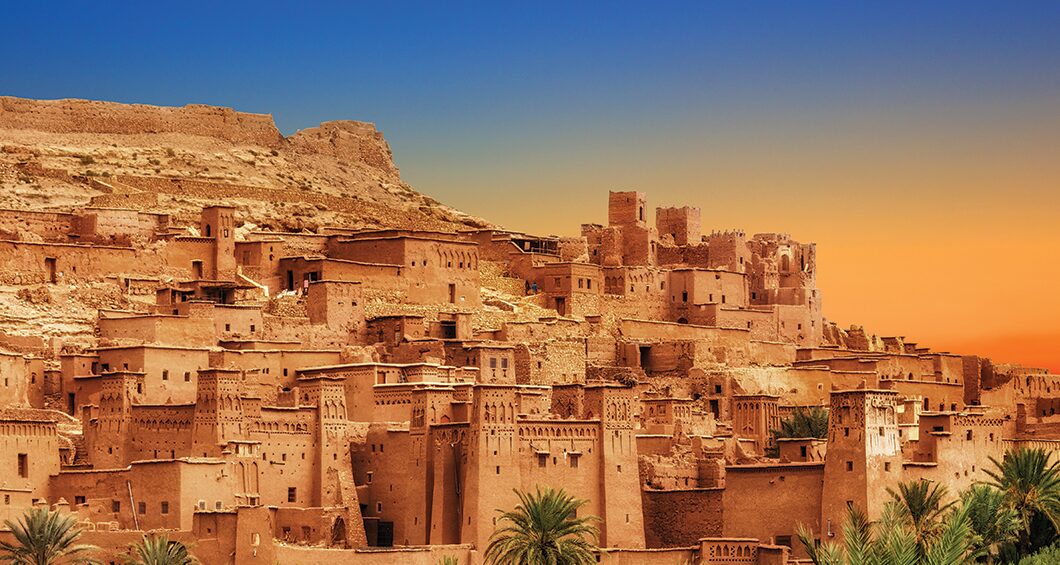
You descend into the pre-Saharan south — the light changes colour, the vegetation disappears, and the first kasbahs appear on every ridge. By early afternoon: Aït Ben Haddou, the UNESCO World Heritage ksar that stood in for ancient Carthage in Gladiator, Yunkai in Game of Thrones, and the desert in Lawrence of Arabia. Cross the river on stepping stones (or the footbridge in flood season), climb to the granary at the summit, look south over the valley.
Lunch in Ouarzazate — the self-styled "Hollywood of Morocco" — with a stop at the Atlas Film Studios if time allows (they filmed everything from Babel to Asterix & Obelix). Overnight in a kasbah-hotel in Ouarzazate: heavy mud-brick walls keep rooms cool even when the valley bakes at 35°C.
Day 4 — Dades Gorge and the Road of a Thousand Kasbahs
The morning drive east from Ouarzazate is called the Route of a Thousand Kasbahs — and it earns the name. Every few kilometres there is another fortified clay tower on a riverbank. Stop at Skoura to walk the palm oasis and photograph the Kasbah Amridil (on the 50-dirham note). Continue through Kalaat M'Gouna in the Valley of Roses — in April the roadside is a wall of pink blossoms.

By early afternoon you reach the Dades Gorge: a slot canyon carved through red limestone, with the river threading far below and the switchback road climbing 10 kilometres into the cliffs. Walk the gorge floor while your driver repositions. The Monkey Fingers rock formations at the gorge head are one of Morocco's best-kept photo secrets.
Overnight in a guesthouse perched on the gorge rim — windows opening onto silence and stars. Todra Gorge (40 minutes further east) is an alternative stop: 300-metre vertical walls so narrow you can touch both sides. We include whichever your group prefers, or both if you start early.
Day 5 — Merzouga and the Erg Chebbi Sahara
The longest drive day — around five hours — and completely worth every kilometre. The road crosses the Draa Valley and the Jebel Sahro range, drops through Erfoud (fossil capital of Morocco — the marble inlaid into half the world's hotel lobbies starts here), and then, without warning, the dunes appear.
Erg Chebbi, near Merzouga, is not the modest sand of Agafay or Zagora. These are 150–200 metre Saharan dunes — the real thing, the bucket-list image, the reason Morocco appears on every "before I die" travel list. The dune field is 22 km long and turns every shade from pale gold to deep amber as the sun moves.
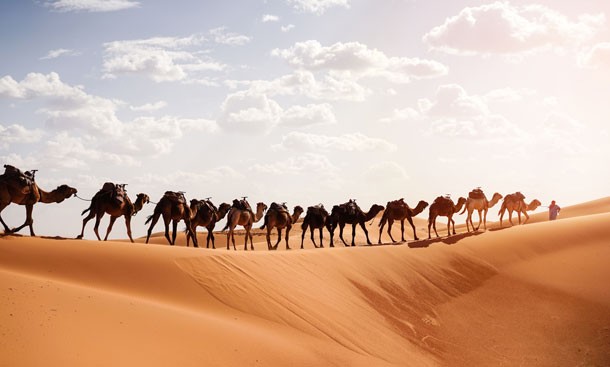
Arrive by late afternoon for the camel trek: your guide leads the caravan into the dunes as the sun sets — an hour or so of golden light that no filter can improve on. The desert camp is set up beyond the first dune line: Berber tents with proper beds (private camps for our clients — not the 200-person party camps), traditional dinner, musicians around the fire, and a sky so thick with stars you won't check your phone once.
Morning of Day 6: wake before sunrise, climb the nearest dune, watch the Sahara turn pink. One of those moments that confirms why you came.
Day 6 — Return via Ouarzazate: Taourirt Kasbah & Draa Valley
The return leg west gives you a different angle on the landscape. Morning at Merzouga — swim (some camps have pools), a final walk in the dunes, or just tea in the quiet before the drive.
The route back takes you through Zagora and the long Draa Valley — date-palm oases, nomad encampments, and the ancient caravan route that once connected sub-Saharan Africa to Marrakech. Stop at the Kasbah of Tamnougalt (15th-century fortified village, accessible with your guide) or the Draa Valley viewpoint above Agdz.
Late afternoon: Ouarzazate for the Taourirt Kasbah — the Glaoui family's main fortress, partly inhabited until the 1990s, with a free-to-wander old town that most tourists walk past without noticing. Overnight in Ouarzazate.
Day 7 — Tizi n'Tichka return & Marrakech finale
The final morning re-crosses the Atlas from the south — the same pass as Day 3 but in reverse, so the views are completely different. Stop at a roadside Berber ceramic workshop in the foothills (the geometric patterns on the pottery are 3,000 years old and still hand-painted).
Back in Marrakech by early afternoon. You have the rest of Day 7 free: the Majorelle Garden (Yves Saint Laurent's blue botanical garden in the Gueliz district), the Museum of African Contemporary Art Al Maaden, a final mint tea and pastilla in the medina, or simply a hammam at your riad before your flight.
What's included in our private 7-day tour
- Private licensed guide (Ministry of Tourism certified) for all sites and driving days
- Private air-conditioned vehicle with experienced driver
- All accommodation (riads, kasbah hotels, desert camp) — 6 nights, breakfast and dinner daily
- Camel trek into Erg Chebbi and overnight desert camp with dinner and musicians
- All entrance fees for listed sites (Aït Ben Haddou, Bahia Palace, Ben Youssef Madrasa, Taourirt Kasbah)
- Free 24-hour itinerary planning service — tell us your interests and we'll personalise before you book
Not included: flights, lunches on driving days (we stop at good local restaurants), personal travel insurance, tips.
Pacing tips
Don't try to add Fes or Chefchaouen. Seven days sounds long until you're on the road. The Marrakech–Sahara loop alone takes everything — adding Fes requires a minimum of 10 days to avoid spending half the trip in a car. If you want Fes, we recommend flying Marrakech → Fes separately and building a 10–12 day itinerary.
Resist the urge to add Essaouira. It's a beautiful Atlantic coast town — but it's west of Marrakech, and the Sahara loop goes east. Essaouira works perfectly as a standalone day trip before or after this itinerary, not grafted onto it.
Todra and Dades? Yes, if you're in a group of two or more and start Day 4 before 8 a.m. They're 40 minutes apart and both reward at least an hour each.
Sunrise at Merzouga requires waking at 5:30 a.m. — it is non-negotiable and universally agreed to be worth it.
Best time for a 7-day Morocco itinerary
| Season | Conditions | Verdict |
|---|---|---|
| October – November | 24–30°C Marrakech, 18–25°C South, cool Atlas nights | Best overall — post-summer crowds, autumn light, Sahara not yet cold |
| March – May | 20–28°C, roses in bloom (April), green Atlas | Excellent — Valley of Roses peak, wildflowers in gorges |
| December – February | Cold nights in Sahara (0–5°C), possible Atlas snow | Good for Atlas hikers; bring sleeping layers for the desert camp |
| June – August | Sahara 40°C+, driving is hot | Manageable with early starts; avoid midday outdoor activity |
The shoulder months of October and April are our most popular departure windows. If you can travel in April, the Valley of Roses between Kalaat M'Gouna and Dades is one of the most beautiful things in Morocco — 3,000 tonnes of Damask roses harvested over two weeks, the whole valley fragrant and pink.
Customisation options
Marrakech + Fes + Sahara variant (10–12 days): add Fes, Meknes, and Volubilis before joining the southern Sahara loop. Flies Marrakech → Fes, tours the north, then drives south to Sahara and back to Marrakech. For groups with more time, this is the gold-standard Morocco itinerary.
Active upgrade: replace Day 2 city morning with a half-day mule trek above Imlil in the Atlas. Replace one kasbah stop with a gorge hike guided by a local Amazigh mountain guide.
Family pacing: add an extra night in Dades or Merzouga, cut one kasbah stop. Children under 10 do the first 30 minutes of camel trek and then switch to 4WD — works perfectly.
Luxury tier: swap kasbah hotels for five-star desert lodges (Adrère Amellal tier), add a private hot-air balloon over Marrakech on Day 1 morning.
Browse all route options at /destinations or speak to us directly at /#contact.
Internal links to plan alongside this itinerary
- All tours from Marrakech — full portfolio with private and small-group formats
- Marrakech guided tours — Day 1 medina programme in detail
- 3-day Merzouga Sahara tour — the condensed desert-only loop
- Day trips from Marrakech — for add-on days before or after
7-day Morocco itinerary — FAQ
The questions we answer most when clients are planning a one-week Morocco trip.
Seven days is enough to see Morocco's highlights — Marrakech's medina, the High Atlas, the Draa Valley kasbahs, and the Erg Chebbi Sahara — if you focus on one coherent loop rather than trying to cross the entire country. It is not enough to add Fes, Chefchaouen, or the Atlantic coast to the same trip without spending half your holiday in a car. For a complete Morocco experience, 10–12 days is the sweet spot.
Plan your week with us. Our licensed guides respond to every enquiry within 24 hours with a personalised itinerary and a single transparent quote. Tell us your dates at /#contact, or browse all departure options at /tours-from-marrakech.
Filed under
Morocco Journal
Let's turn this story into your itinerary.
Explore private Morocco itineraries and ask our local team to tailor the route to your dates and travel style.
Continue reading
All stories →10-Day Morocco: Marrakech, Fes & Chefchaouen
The definitive 10-day Morocco itinerary: Marrakech, Atlas, Sahara dunes, Fes medina & Chefchaouen blue city — paced, private, and arranged by licensed local guides.

Road of the Thousand Kasbahs: Marrakech to Ouarzazate, Dades & Sahara Guide
Drive Morocco's Road of 1,000 Kasbahs from Marrakech to Aït Ben Haddou, Skoura, Dades and Merzouga with distances, stops and overnight advice.

Day Trips from Marrakech: 9 Best Excursions (2026)
The 9 best day trips and excursions from Marrakech, ranked by what they actually deliver — Atlas Mountains, Agafay, Ourika, Essaouira, Aït Ben Haddou, Ouzoud and the Sahara. Distances, timings, best seasons and which to skip, from a Marrakech-based agency.