
By Marrakech Riads & Tours guide team — Local Morocco travel specialists
Road of the Thousand Kasbahs: Marrakech to Ouarzazate, Dades & Sahara Guide
Drive Morocco's Road of 1,000 Kasbahs from Marrakech to Aït Ben Haddou, Skoura, Dades and Merzouga with distances, stops and overnight advice.


There are roughly 300 surviving kasbahs in southern Morocco — fortified earthen strongholds built by Berber clans between the 16th and early 20th centuries. Most of them sit along a 600-kilometre stretch of road between Marrakech and the Sahara that locals and travel agents call the Road of the Thousand Kasbahs.
Drive it slowly, with the right overnight stops, and you cross three of Morocco's most cinematic landscapes — the High Atlas, the Dades and Draa valleys, and the Erg Chebbi dunes — without backtracking once. This is the route we plan for every Marrakech-to-Sahara guest, with the stops most tour buses skip.
The full route at a glance
| Day | Stop | Drive | Sleep |
|---|---|---|---|
| 1 | Marrakech → Aït Ben Haddou (via Tizi n'Tichka pass) | 4h | Kasbah near Aït Ben Haddou |
| 2 | Aït Ben Haddou → Ouarzazate → Skoura → Dades Gorge | 4h 30 | Dades Gorge guesthouse |
| 3 | Dades → Todra Gorge → Merzouga | 5h | Sahara desert camp |
| 4 | Merzouga sunrise → return Marrakech via Tizi n'Tichka | 9h | Marrakech |
If you have more time, add Step 5 (Draa Valley + Zagora) as an alternative loop south through Agdz and Zagora before joining the Marrakech road at Tazenakht.
Step 1 — Marrakech to Aït Ben Haddou (4 hours)
The road climbs over the Tizi n'Tichka, the highest paved mountain pass in North Africa at 2,260 m. Two recent improvements:
- The pass was reopened with a tunnel section in 2025 → no more 30-minute switchbacks at the summit
- Berber roadside cafés near Taddert village are now the most reliable lunch stop
Just past Tizi n'Tichka, detour to Telouet (20 km off the main road) — the abandoned Glaoui kasbah, once the home of the most powerful pre-independence Berber clan in Morocco. Vast painted-cedar ceilings, almost zero tourists. The road is rough but passable in a normal sedan.
Aït Ben Haddou — the UNESCO ksar
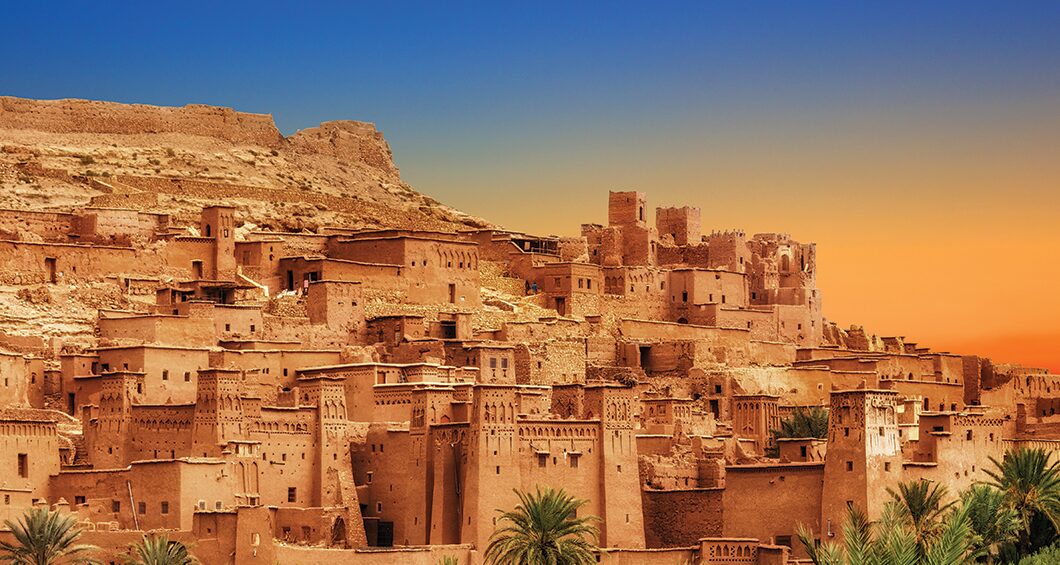
The ksar (fortified village) of Aït Ben Haddou is the most famous kasbah complex in Morocco — UNESCO-listed in 1987 and the filming location for Gladiator, Game of Thrones, Lawrence of Arabia and The Mummy. The 30-minute walk to the granary at the top gives the best photo and the panorama over the wadi.
Tip: stay overnight on the far side of the river (not in Aït Ben Haddou village itself). Sunset and sunrise light on the ksar is incredible from the riverbank guesthouses.
Step 2 — Ouarzazate, Skoura, Dades Gorge (4h 30)

Ouarzazate — "Hollywood of Africa"
The gateway city to the desert. Visit Atlas Studios (where Gladiator, Cleopatra and Game of Thrones were shot — guided 1-hour tours, 80 MAD) and the 17th-century Taourirt Kasbah on the eastern edge of town.
Skoura — the palm oasis
60 km past Ouarzazate, Skoura is a 150,000-tree palm grove with a dozen restored kasbah hotels hidden inside. Stop at Kasbah Amridil (pictured at the top of this post) — built in 1675, family-run as a museum, original wooden lock mechanisms still in use.
El Kelaâ M'gouna — Valley of Roses
Famous for the Damask roses distilled into rose water. Best in late April / early May when the rose harvest festival fills the town. The road climbs to a viewpoint over the M'goun massif — pull over for it.
Dades Gorge

The road ducks into the Dades Gorge with its famous "Monkey Fingers" rock formations and a hairpin descent into the valley below. Several guesthouses cling to the gorge walls — book one with a south-facing terrace for the sunset.
Step 3 — Dades to Todra to Merzouga (5 hours)
Todra Gorge
A 160-metre-deep limestone slot carved by the Todra River. The road actually passes through the gorge bottom — you drive between sheer cliffs with the river 2 metres from your wheels. World-class rock climbing if you're staying overnight.
The Sahara — Erg Chebbi at Merzouga
After Tinghir the landscape flattens, the heat rises, and the dunes of Erg Chebbi appear on the eastern horizon. The dunes are 150 metres tall at their highest, stretching 22 km north-to-south. You'll switch from your car to a 4x4 (or camel) at the camp's vehicle drop-off, then ride 30 minutes into the dunes to your tent.
Sunset camel trek + dinner around the fire + sunrise over the dunes = the night that everyone remembers from their Morocco trip. Read our tours from Marrakech for the full Sahara routing.
Step 4 — Return to Marrakech
Two options for the return:
- Same road back (9 hours via Tizi n'Tichka) — long day but you're already familiar with the route
- The Draa Valley loop — south from Merzouga via Erfoud, Rissani, Zagora, Agdz, then Tazenakht and back to Marrakech. 12 hours total but you see the Draa Valley palm groves (200 km of continuous oasis — the longest palm grove in the world)
If you have an extra day, the Draa loop is genuinely better. Stay overnight in Zagora at a kasbah on the M'Hamid road.
Alternative — the southern loop via Zagora
For travellers with more time and a love of palm groves over dunes:
| Day | Stop | Drive |
|---|---|---|
| 1 | Marrakech → Aït Ben Haddou | 4h |
| 2 | Aït Ben Haddou → Agdz → Zagora | 4h 30 |
| 3 | Zagora → Tinfou dunes → return | full day |
| 4 | Zagora → M'Hamid → Chigaga dunes camp | 4h + 2h 4x4 |
| 5 | Chigaga → Marrakech via Foum Zguid | 11h |
Chigaga dunes are less touristed than Erg Chebbi and the drive to them through Foum Zguid is one of the wildest desert roads in Morocco.
When to drive the Road of the Kasbahs
October to April is the sweet spot. July and August reach 45°C+ in the desert sections and the south becomes punishing. Best months: late October to early April for the dunes (warm days, cold nights, no heatstroke risk).
What kind of car / driver
- Self-drive in a normal sedan — fine for the main paved route. Avoid in winter snow on Tizi n'Tichka without checking conditions.
- Self-drive 4x4 — required only if you want off-piste sections (Telouet road, Chigaga dunes access, side gorges)
- Driver-guide service — by far the most relaxed option. Roads are scenic but long, signage gets thin, and a local driver knows which kasbahs to stop at. We arrange Mercedes V-Class or Toyota Land Cruiser with English/French-speaking drivers for our guests.
Where to sleep along the Road of the Kasbahs
We recommend these by stop (all hand-selected):
- Aït Ben Haddou — riverside kasbah on the far bank, with view of the ksar
- Ouarzazate — boutique guesthouse near the Taourirt kasbah
- Skoura — palm-grove kasbah hotel with pool
- Dades Gorge — guesthouse perched on the canyon edge
- Merzouga — comfort-tier desert camp inside Erg Chebbi (private tent, en-suite, multi-course dinner)
- Zagora (optional loop) — Draa Valley kasbah with palm-grove views
See our full Where to Stay in Morocco guide for accommodation types and price ranges.
Book this route as a private tour
We run this exact 4-day private tour year-round, customisable to your dates and pace. Includes: private driver in a Mercedes V-Class, all overnight accommodation, dinner + breakfast, 4x4 dune transfer, camel trek, desert camp, all park fees.
See our existing Marrakech, Atlas & Agafay adventure or Southern Morocco comfort tour for the ready-to-book versions — or contact us for a tailored quote.
Road of the Kasbahs — FAQ
How many days do I need for the Road of the Kasbahs? Minimum 3 days, ideal 4 days. Anything less and you're either skipping the Sahara overnight (the whole point) or driving 16+ hours in a single day.
Can I do it without a driver? Yes — roads are paved and signposted in French and Arabic. But the driving is 9 hours total over 4 days and the most beautiful detours (Telouet, Skoura kasbahs, side gorges) are easy to miss without local knowledge.
Are the kasbahs open to visit? Most working-museum kasbahs (Taourirt, Aït Ben Haddou, Amridil) have set hours and small entry fees (10-30 MAD). Many private kasbahs have been converted to hotels and welcome non-guests for lunch or tea if you ask politely.
What should I pack? Layers — desert nights drop to 5°C in winter. Headscarf for dune protection. Sun hat, sunglasses, sunscreen 50+. Hiking shoes for the kasbah climbs. A power bank — there's no electricity in the desert camp.
Is the route safe for solo female travellers? Yes, with the usual common-sense precautions. Drivers and kasbah staff are professional. We've taken many solo female guests on this route without incident.
Filed under
Morocco Journal
Let's turn this story into your itinerary.
See private day trips and multi-day routes from Marrakech, planned with licensed local guides.
Continue reading
All stories →
7-Day Morocco Itinerary from Marrakech (Atlas+Sahara)
The definitive 7-day Morocco itinerary from Marrakech: medina, Atlas Mountains, Aït Ben Haddou, Dades Gorge, Merzouga Sahara camp, and back — private, paced, and local-guided.

Aït Ben Haddou Day Trip from Marrakech: Guide
Complete guide to visiting the UNESCO ksar of Aït Ben Haddou from Marrakech — Tizi n'Tichka pass, Ouarzazate film studios, GoT locations, and the honest case for staying overnight.

Marrakech to Sahara: 3-Day Merzouga Desert Guide
Your complete guide to a 3-day Sahara desert tour from Marrakech — Erg Chebbi dunes, camel trek, desert camp, and the route that makes it worth the drive.