
By Marrakech Riads & Tours guide team — Local Morocco travel specialists
Marrakech to Sahara: 3-Day Merzouga Desert Guide
Your complete guide to a 3-day Sahara desert tour from Marrakech — Erg Chebbi dunes, camel trek, desert camp, and the route that makes it worth the drive.

There is a version of the Sahara you can visit from Marrakech in a single day. The dunes are about 45 minutes from your riad, the camel ride takes 20 minutes, and you're back in time for dinner. That version is called Agafay — a beautiful stone desert in the Atlas foothills — and it is not the Sahara.
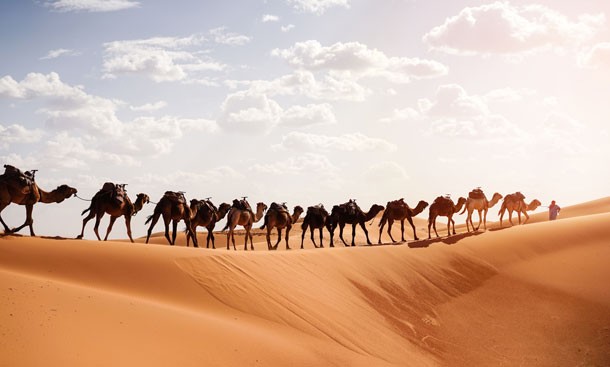
The real Sahara is Erg Chebbi, near the village of Merzouga, in the far southeast of Morocco. The dunes here rise 150 metres out of the flat hamada, running 22 kilometres north to south — one of the largest sand seas in North Africa. It takes 9 to 10 hours to drive there from Marrakech. Any operator selling a "1-day Sahara trip from Marrakech" is either driving through the night and delivering a sleep-deprived guest at sunrise, or taking you somewhere much smaller and calling it the Sahara.
Done properly, the Marrakech-to-Sahara journey takes three days. And those three days are some of the best travel you will do in Morocco — the road across the High Atlas, a UNESCO World Heritage kasbah, gorges carved by ancient rivers, and finally an orange horizon of dunes so big they have their own weather. This guide gives you the exact route, what to expect each day, and how to choose your camp.
The 3-day Sahara tour from Marrakech — quick facts
| Distance | Marrakech → Merzouga: ~560 km |
| Driving time | 9–10 hours (split over 2 days) |
| Dune height | Up to 150 m (Erg Chebbi) |
| Best season | October to April |
| Minimum nights | 2 (but 3 is the sweet spot) |
| What you need | Private car + driver, no 4WD required on tarmac |
| Languages | Arabic, Tamazight (Berber), French, some English |
Day 1 — Marrakech → Tizi n'Tichka → Aït Ben Haddou → Dades Valley
Distance: ~350 km / 6–7 hours driving
Depart Marrakech early — 7:30 a.m. is ideal. The first 90 minutes take you south through the High Atlas on the N9 road, climbing steadily to the Tizi n'Tichka pass at 2,260 metres. This is the highest road pass in Morocco, and in winter it is genuinely dramatic: snow-dusted berber villages, cedar forests, and the whole Marrakech plain receding behind you. In spring, wildflowers line the road and the Atlas is still snowcapped.
The descent brings you to Aït Ben Haddou — the terracotta fortress ksar that has appeared in Gladiator, Game of Thrones, Lawrence of Arabia and The Mummy. It is UNESCO-listed, and it earns that status. Cross the dry river bed, walk up through the narrow streets to the granary at the top, and spend at least 90 minutes here before continuing. This is not a quick photo stop.
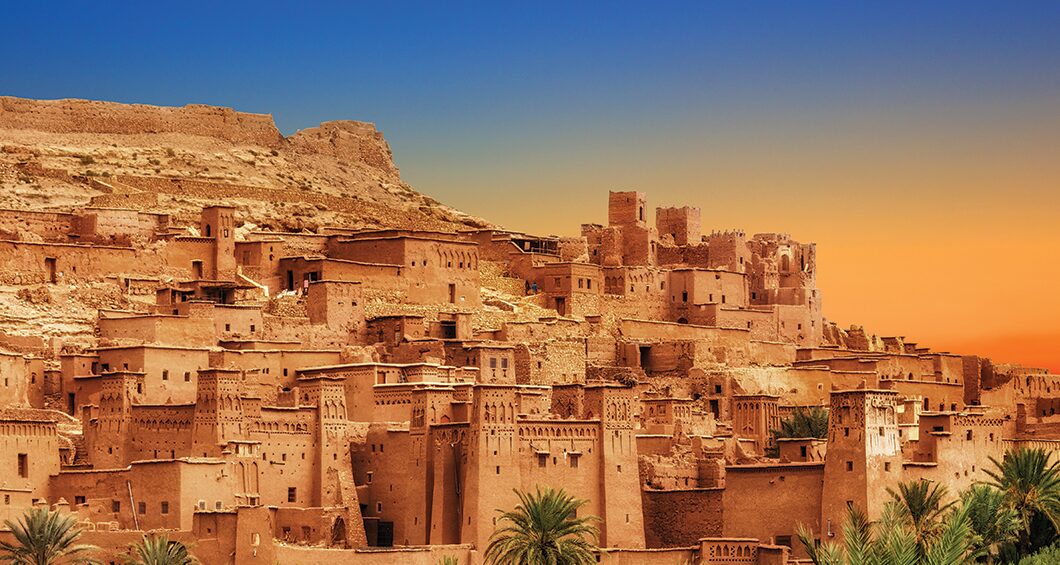
From Aït Ben Haddou the route east passes through Ouarzazate (the "Hollywood of Africa" for its film studios) and then continues into increasingly dramatic country: the Skoura palm oasis, then the Roses Valley near El Kelaa M'Gouna (blooming in April and May with tens of thousands of Damask rose plants).
End your first night in the Dades Valley — the broad red-rock corridor east of Skoura, flanked by dramatic cliff formations and ancient kasbahs. A kasbah guesthouse here typically puts you at around 1,200 metres and the air is clear and cool. Dinner on the roof terrace, mountain silence. This is already worth the trip.

Day 2 — Dades Valley → Todra Gorge → Merzouga, camel trek to desert camp
Distance: ~220 km / 4 hours driving
After breakfast, a short detour north takes you into Todra Gorge — a 300-metre-deep slot canyon where the Todra river still runs cold between walls that narrow to 10 metres. A short walk up the canyon floor is one of the most photographed landscapes in Morocco. Rock climbers come from across Europe to tackle these walls; most visitors simply walk 20 minutes in and stand in the shade with their heads tilted back.
Then east on the N10, and the landscape starts to change. The reddish mountain rock gives way to flat gravel plains — the hammada — and somewhere around the town of Erfoud you see the first fingers of orange sand on the horizon. By the time you reach Merzouga village in the early afternoon, Erg Chebbi fills the entire eastern horizon: a wall of dunes, razor-edged crests, utterly silent.
Check in at your camp's reception point in Merzouga village — all luggage is left here, because camels do not carry rolling suitcases. Pack a small overnight bag (sleeping clothes, a layer, phone charger, toiletries) and walk to the dune edge.
The camel trek to camp takes 45 minutes to one hour. Your guide leads a string of camels in single file; the pace is slow and the views improve with every minute. Sunset at the top of a dune — watching the orange light drain from the crests while the shadows climb the windward faces — is genuinely difficult to describe to someone who hasn't seen it. Take your shoes off. The sand is still warm from the day.
Camp dinner is typically a Berber tagine and couscous around a fire, with musicians if you're in a group. Nights at Erg Chebbi are exceptionally clear — the nearest city lights are hundreds of kilometres away, and the Milky Way is visible in full on a moonless night.
Day 3 — Sunrise over the dunes → return to Marrakech
Distance: ~560 km / 9 hours driving (or break it up)
Wake at 5:30 a.m. Your guide will already have tea ready. The camel trek back takes the same 45 minutes, but the light is now a cold rose-gold — a completely different palette to sunset. The shadow side of the dunes goes deep blue-purple; the sunlit faces glow. This is the hour that makes the early start worth it.
Collect your luggage at the reception point and begin the return to Marrakech. The return can follow the same route in reverse, or continue west on an alternative route via Rissani (historic Alaouite city), Erfoud and the Ziz Valley — a 70-kilometre palm oasis that follows the Ziz River north toward the Atlas. If time allows, an alternative northern route via Midelt through the Middle Atlas gives you cedar forests and a different flavour of Morocco.
Most guests opt to break Day 3 with a night in Ouarzazate or Aït Ben Haddou, returning to Marrakech on Day 4. This is the version we recommend — three nights means you never feel rushed.
Desert camp options: standard vs luxury bivouac
Camp quality varies considerably in the Merzouga dunes. Here is what the tiers actually mean:
Standard camp (mid-range): Permanent Berber-style tents with proper beds (not mats), en-suite or shared bathroom facilities, hot shower, generator power for charging. Dinner and breakfast included. These camps are 15–30 minutes by camel from the dune edge. Comfortable, authentic, good value.
Luxury bivouac: Freestanding or semi-permanent tents with real beds, private bathrooms, and in some cases heated floors. Better positioned in the dunes, farther from other camps. Higher quality food, smaller group sizes, sometimes a plunge pool or heated hammam at the base. Candlelit dinner, sometimes with a private fire. The difference is genuinely noticeable — if you're doing this trip once, it's worth the premium.

What both tiers share: the same dunes, the same stars, the same camel trek, and the same 5:30 a.m. sunrise. The dunes don't charge extra for the light.
Best time for a Sahara tour from Marrakech
October to April is the prime window. Days are warm (22–32°C), nights are cold (5–10°C at the dunes), and the light is extraordinary.
| Month | Dune temperature | Notes |
|---|---|---|
| October–November | 25–30°C day / 12–15°C night | Ideal. Post-summer crowds gone, warm sand. |
| December–January | 18–22°C day / 3–8°C night | Cold nights — bring a proper sleeping bag layer. Clear skies. |
| February–March | 22–28°C day / 8–12°C night | Best months. Good light, occasional green on the plains. |
| April | 30–35°C day / 15°C night | Getting warm; still manageable, spring wildflowers on the road. |
| May–September | 40–50°C day / 25°C night | Sand temperatures can exceed 70°C. Not recommended. |
Avoid July and August entirely. The heat at Erg Chebbi is physically dangerous at midday.
Agafay vs Merzouga — what's the actual difference?
We get this question on every booking. Here is the honest answer:
Agafay is a rocky, moonscape desert 45 km from Marrakech. It has no dunes, no sand — just rolling hammada with the Atlas Mountains as a backdrop. It is ideal for a half-day or one-night desert experience: sunset camel ride, dinner at a Berber camp, back to your riad by midnight. Excellent for families, those short on time, and anyone who wants a desert feel without the commitment. Our Agafay desert guide covers it in full.
Merzouga (Erg Chebbi) is the real Sahara. Enormous orange sand dunes, 150 metres high, stretching 22 km. The camel trek, the star canopy, the 5:30 a.m. sunrise — none of this exists at Agafay. It requires 3 days minimum and the full 9-hour drive. If dunes are on your bucket list, Agafay will not scratch that itch.
Neither is better. They answer completely different questions.
What's included in a private Sahara tour from Marrakech
When you book a private guided Sahara tour from Marrakech with us, the package typically covers:
- Private vehicle and licensed driver for the entire route
- Licensed English-speaking guide at key sites (Aït Ben Haddou, Todra)
- All accommodation — kasbah guesthouse on Night 1, desert camp on Night 2
- All meals as listed (breakfasts, dinners; lunches can be added)
- Camel trek to and from the desert camp (sunset Day 2, sunrise Day 3)
- Entry fees at Aït Ben Haddou and the Todra Gorge parking
- Hotel pickup and drop-off in Marrakech
Not included: international flights, personal travel insurance, tips, and alcohol (desert camps are dry or BYO in sealed containers).
We quote one transparent price for the group — no per-stop commissions, no hidden extras discovered at the camp gate. Send us your group size and travel dates on the contact form and we'll have a tailored quote back to you within 24 hours.
How to book your desert tour
The Merzouga dunes are best arranged as a private trip rather than a shared tour bus. On a private itinerary you control the pace — longer at Aït Ben Haddou if you want it, straight through Ouarzazate if you don't — and you stay at the camp tier you choose. Shared group tours leave at fixed times, stop at fixed shops (where the driver earns a commission), and use the same mid-range camp regardless of your preference.
Browse our tours from Marrakech for routed options, or compare all destinations if you want to combine the Sahara with a wider Morocco circuit. If you're not sure whether to add the Agafay or the Sahara on your existing itinerary, our day trips guide lays out every option side by side.
Ready to go? Send us your dates and group size — a licensed Marrakech guide will reply within 24 hours with a free, no-obligation itinerary.
Marrakech to Sahara — FAQ
The questions travellers ask us most before booking a desert tour from Marrakech.
Not the real Sahara. Erg Chebbi (Merzouga) is 9–10 hours from Marrakech by road, which means a genuine Sahara trip needs at least 2 nights and 3 days. Any tour marketed as a "1-day Sahara from Marrakech" is either driving through the night or taking you to Agafay (a stone desert 45 minutes away) or the much smaller dunes near Zagora — not Erg Chebbi. If you want the 150-metre dunes, budget three days.
Filed under
Morocco Journal
Let's turn this story into your itinerary.
See private day trips and multi-day routes from Marrakech, planned with licensed local guides.
Continue reading
All stories →
7-Day Morocco Itinerary from Marrakech (Atlas+Sahara)
The definitive 7-day Morocco itinerary from Marrakech: medina, Atlas Mountains, Aït Ben Haddou, Dades Gorge, Merzouga Sahara camp, and back — private, paced, and local-guided.

Agafay Desert from Marrakech: Sunset & Camp Guide
Agafay desert day trip from Marrakech: 45 min away, sunset camel rides, quad biking, luxury Berber camps & dinner under stars. Full guide from licensed local guides.

Road of the Thousand Kasbahs: Marrakech to Ouarzazate, Dades & Sahara Guide
Drive Morocco's Road of 1,000 Kasbahs from Marrakech to Aït Ben Haddou, Skoura, Dades and Merzouga with distances, stops and overnight advice.